
BECOME UNFORGETTABLE!
How to Build a Brand People
Recognise, Trust & Remember
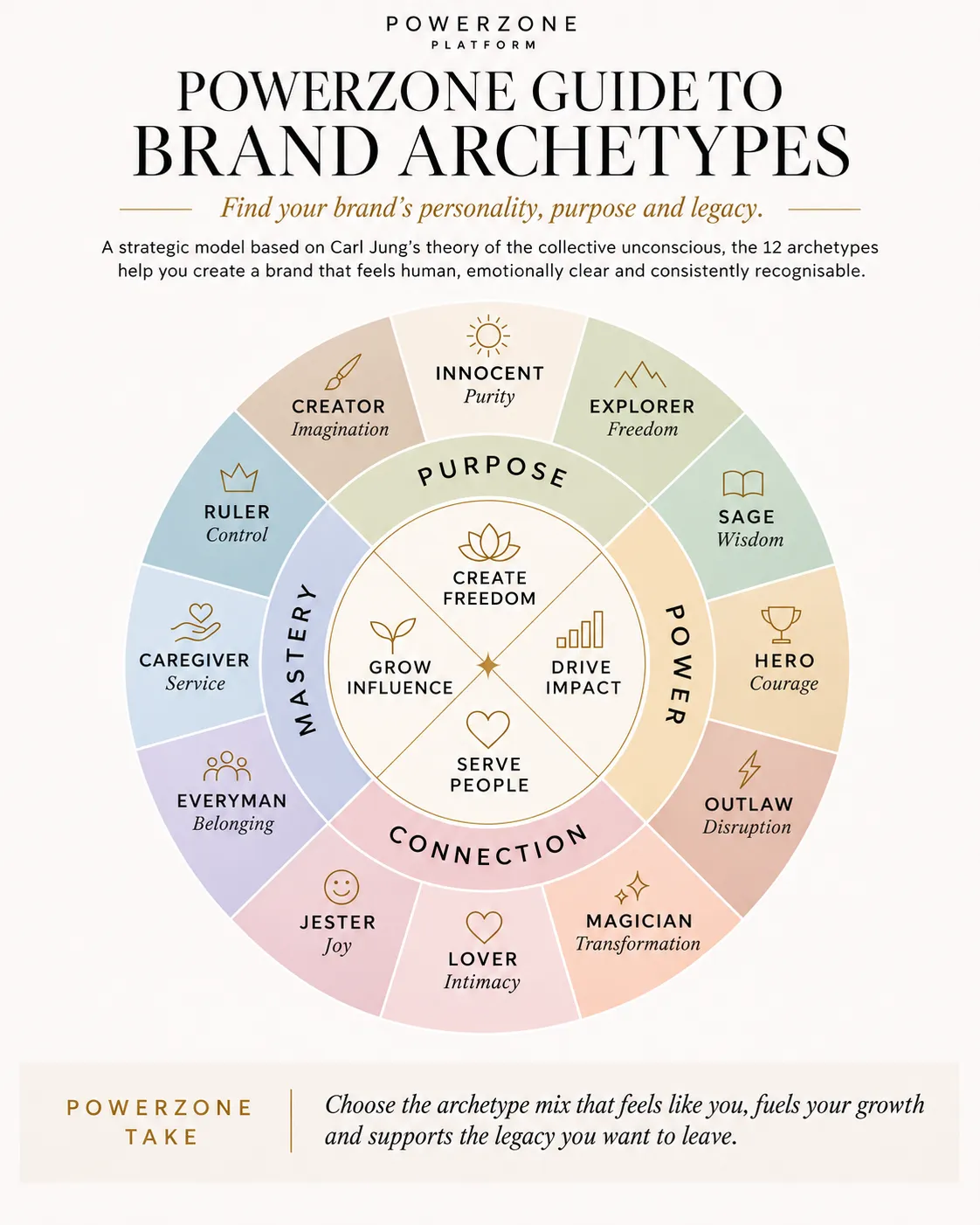
The 12 Brand Archetypes:
What do Oprah Winfrey, Serena Williams, Anna Wintour, Dolly Parton and Rihanna have in common?
They are all instantly recognisable. And not simply because they are famous.
Each has built a distinct identity around the way she communicates, what she represents, how she makes people feel and what people have come to expect from her.
You know what you're getting with Anna Wintour. You know what Serena Williams stands for. And you can probably imagine how Dolly Parton would respond to a situation without ever having met her.
That's the power of a recognisable personal brand.
Now, think about your own business.
If someone landed on your website, Instagram profile or LinkedIn page today, would they immediately understand what you're about?
Would they recognise your personality?
Would your marketing feel consistent, or would it look like you've borrowed a little inspiration from five different businesses and hoped for the best?
I see this happen all the time, particularly with women building businesses around their own expertise.
They're brilliant at what they do. They care about their clients. They have experience, ideas and so much value to offer.
But when it comes to communicating that value, their brand is often trying to be everything at once.
Professional. Friendly. Inspirational. Educational. Fun. Luxurious. Approachable. Empowering.
And somewhere along the way, their actual personality gets lost.
Your brand doesn't need to appeal to everybody. It needs to mean something to the right people.
This is where brand archetypes become incredibly useful.
They give you a framework for understanding the personality behind your business, the emotional connection you want to create and how to make your marketing more consistent.
And no, you don't need to become a completely different person or hire an expensive branding agency to work it out.
You just need to understand what makes your brand recognisable.
What exactly is a brand archetype?
A brand archetype is a recognisable personality pattern that helps explain how a business communicates, behaves and connects emotionally with its audience.
Think about the different women you might turn to in your life.
You might have one friend who always gives you practical, well-researched advice.
Another who encourages you to take risks and go after what you want.
One who makes you laugh when everything feels overwhelming.
And another who makes you feel safe, supported and understood.
Each woman brings something different to your life.
Businesses can work in much the same way.
Some brands make us feel ambitious. Others make us feel reassured. Some encourage us to question the rules. Others help us imagine an entirely different future.
Those emotional associations are part of what makes a brand memorable.
The brand archetype framework gives us 12 personalities to work with, each representing different motivations, desires and characteristics.
It's a way to create consistency without sacrificing individuality.
Where do the 12 brand archetypes come from?
The concept has its roots in the work of Swiss psychiatrist Carl Jung, who developed the theory of the collective unconscious.
Jung proposed that people share certain recurring psychological patterns, symbols and stories that appear across cultures, myths and human experiences.
These patterns became known as archetypes.
The specific framework of 12 brand archetypes was later popularised in marketing by Margaret Mark and Carol S. Pearson in their 2001 book, The Hero and the Outlaw: Building Extraordinary Brands Through the Power of Archetypes.
Their work explored how businesses could use these recognisable personality patterns to develop stronger, more consistent brand identities.
It's worth understanding that archetypes are a strategic and interpretive framework, not a scientifically validated personality test or a guaranteed formula for business success.
But as a marketing tool, they can be extremely helpful.
They encourage you to look beyond logos, fonts and colours and ask a much more important question:
How do I want people to feel when they interact with my business?
Because branding is about much more than what people see.
It's about what they remember.
The 12 brand archetypes at a glance
Every archetype represents a different motivation. And while we can probably recognise elements of several in ourselves, most businesses benefit from having one clear primary archetype, with a secondary archetype adding personality and depth.
Here are the 12, with examples of women whose public personas illustrate their characteristics.
These are illustrative interpretations, not official archetype classifications or claims that these women consciously use the framework.
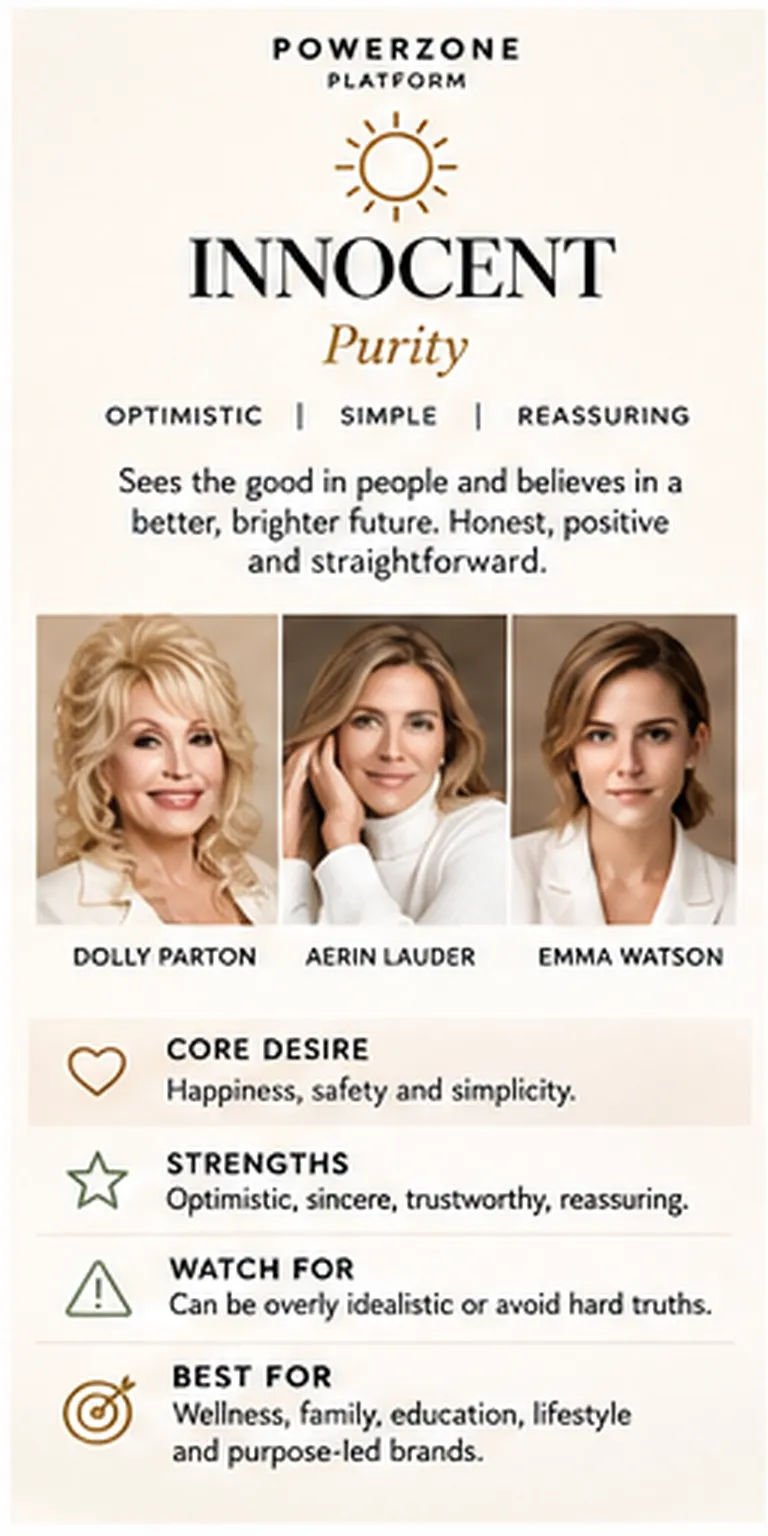
The Innocent: Simplicity, optimism and trust
Core desire: Happiness, safety and simplicity.
The Innocent sees possibility in the good things in life. This brand personality is optimistic, sincere, reassuring and uncomplicated.
It doesn't need to shock people to attract attention.
It builds connections through honesty, positivity and a sense of comfort.
Women who illustrate the Innocent:
Dolly Parton, for her warmth, optimism and approachable public personality.
Aerin Lauder, for her understated, classic approach to beauty and lifestyle.
Julie Andrews, for the grace and reassurance associated with her public image.
Emma Watson, particularly aspects of her thoughtful and values-led public work.
For your business: The Innocent could work beautifully for a family wellness business, a natural skincare brand, a gentle parenting educator or a coach helping clients simplify their lives.
Your marketing message might sound like: "You don't need to complicate everything. Sometimes the simplest approach is the most effective."
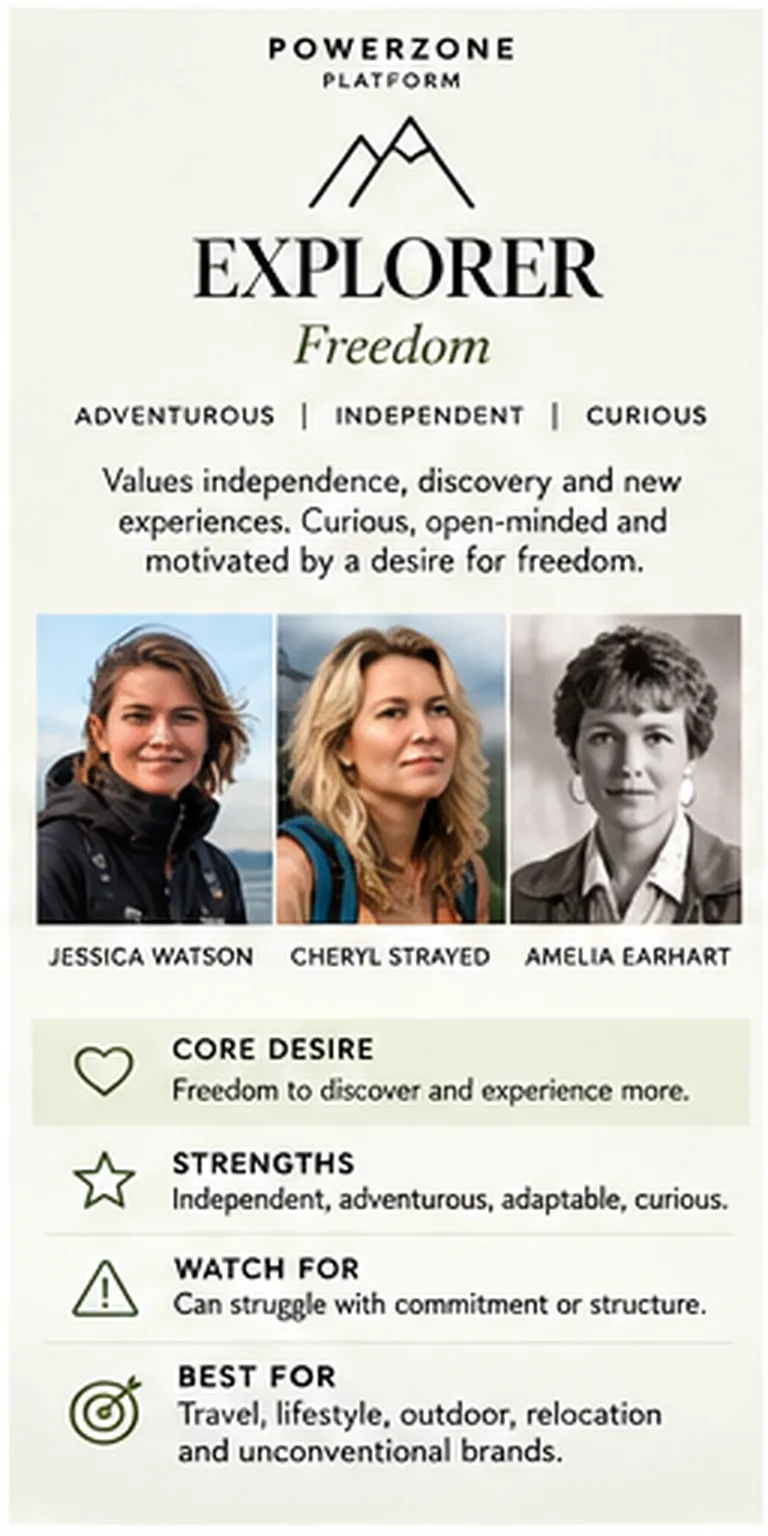
The Explorer: Freedom, independence and discovery
Core desire: Freedom to discover and experience more.
The Explorer values independence, curiosity, new experiences and the ability to choose a different path.
She doesn't want to follow the conventional route simply because everyone else is doing it.
Explorer brands encourage people to move beyond their comfort zones and discover what's possible.
Women who illustrate the Explorer:
Jessica Watson, the Australian sailor who completed a solo circumnavigation as a teenager.
Cheryl Strayed, author of Wild.
Amelia Earhart, the pioneering aviator.
Freya Hoffmeister, known for her long-distance sea kayaking expeditions.
Alexandra David-Néel, the pioneering explorer and writer.
For your business: This personality could suit a travel business, adventure coach, digital nomad mentor, relocation specialist or lifestyle entrepreneur encouraging women to live more independently.
Your marketing message might sound like: "You don't have to live the life everyone expects of you."
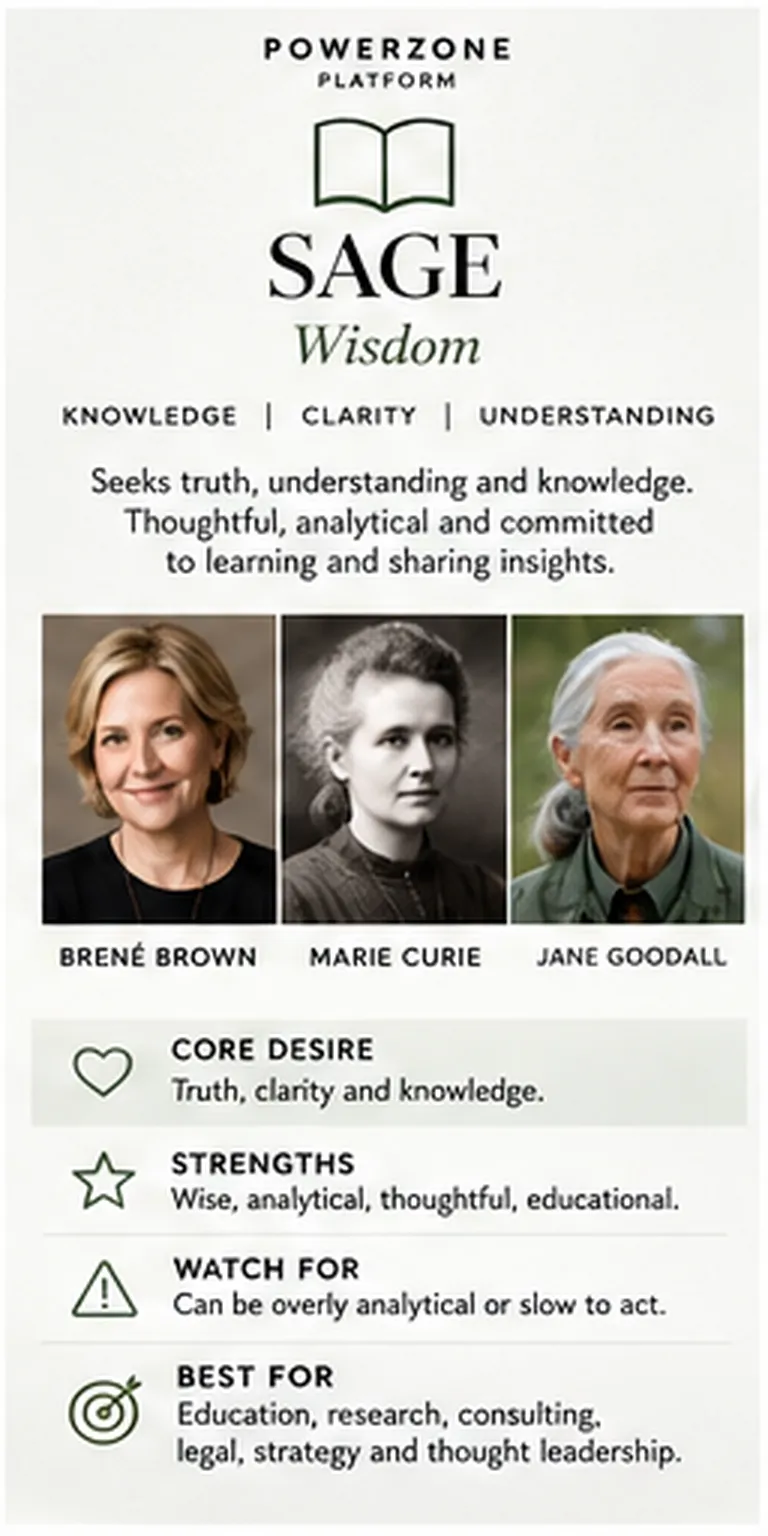
The Sage: Knowledge, wisdom and understanding
Core desire: Truth, clarity and knowledge.
The Sage believes that better understanding leads to better decisions.
This brand personality is analytical, educational, thoughtful and committed to sharing useful information.
The Sage doesn't need to be the loudest person in the room.
She earns credibility by helping people understand things more clearly.
Women who illustrate the Sage:
Brené Brown, for her research-led conversations about vulnerability and courage.
Marie Curie, for her dedication to scientific discovery.
Jane Goodall, for her research, education and advocacy.
Esther Perel, for her exploration of human relationships.
Mel Robbins, for her practical, educational approach to personal development.
Dr Lisa Feldman Barrett, for her work explaining the science of emotion.
For your business: The Sage is particularly valuable for consultants, educators, researchers, legal professionals, psychologists and coaches who build authority through knowledge.
Your marketing message might sound like: "Before you make another decision, let's understand what's actually happening."
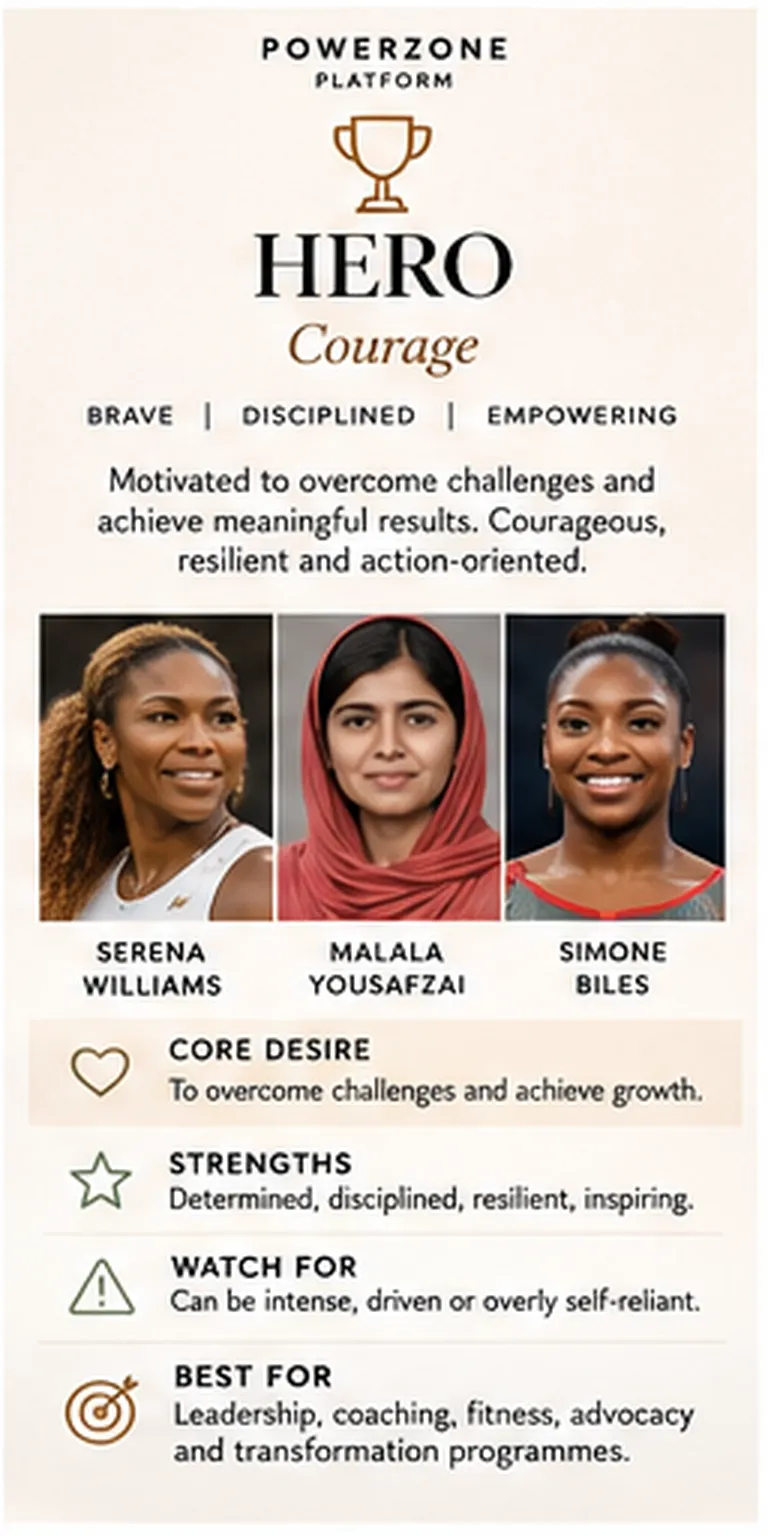
The Hero: Courage, achievement and empowerment
Core desire: To overcome challenges and achieve meaningful results.
The Hero is determined, courageous, disciplined and willing to do the difficult work.
Hero brands are about progress, achievement and helping people believe they can overcome obstacles.
They don't simply promise improvement. They encourage action.
Women who illustrate the Hero:
Serena Williams, for her competitive excellence and resilience.
Malala Yousafzai, for her courage and advocacy for girls' education.
Simone Biles, for her achievements and willingness to challenge expectations.
Cathy Freeman, for her extraordinary sporting accomplishments.
Jacinda Ardern, for aspects of her values-led leadership through difficult circumstances.
Michelle Obama, for her emphasis on confidence, education and personal growth.
For your business: The Hero can work especially well for business coaches, leadership mentors, fitness professionals and advocates helping people overcome substantial challenges.
Your marketing message might sound like: "You are capable of more than you think. Now let's build the strategy to get you there."
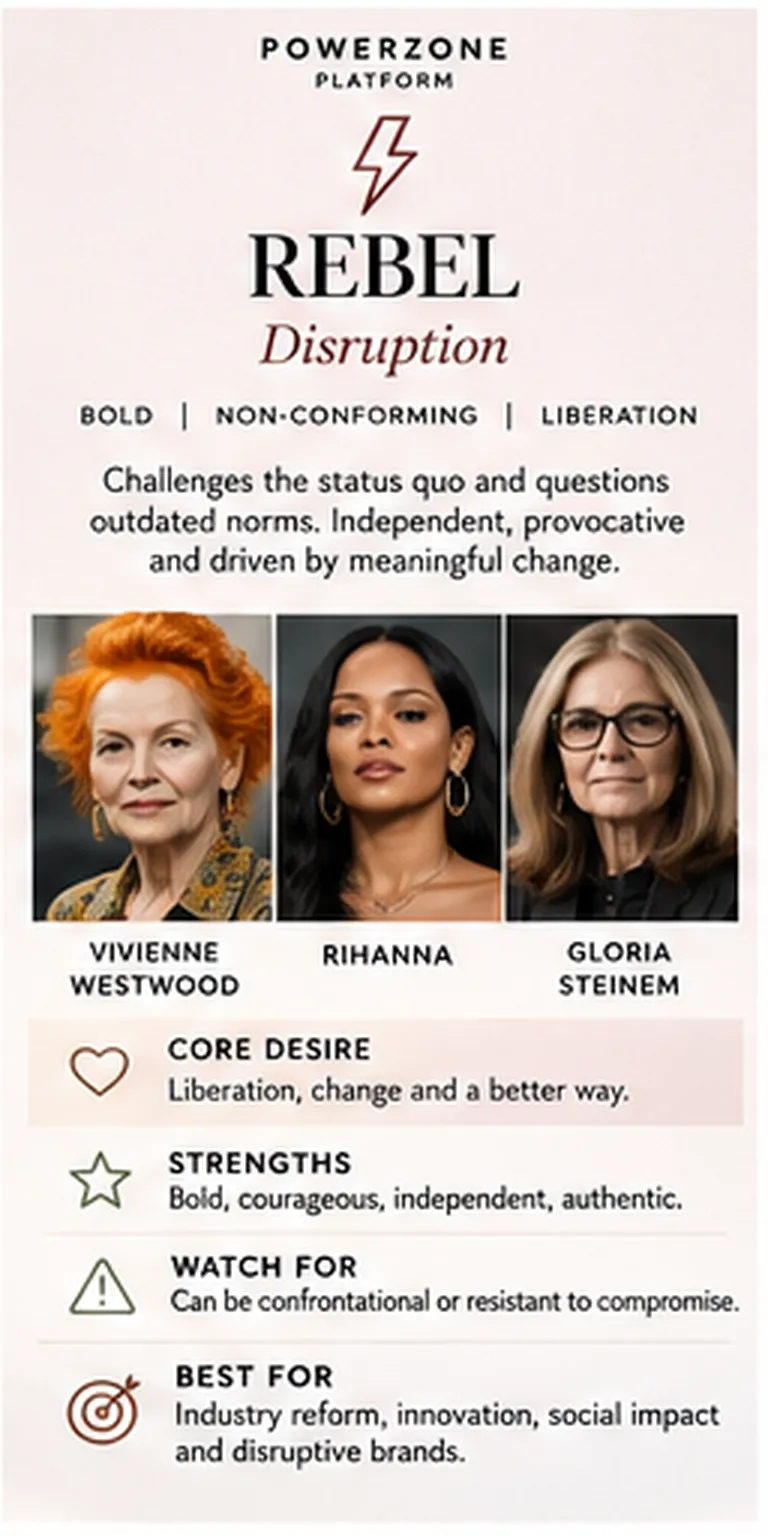
The Rebel: Disruption, independence and challenging convention
Core desire: Liberation and meaningful change.
The Rebel questions assumptions.
She isn't interested in doing things a certain way simply because that's how they've always been done.
Rebel brands challenge outdated thinking, confront industry problems and encourage people to consider alternatives.
But being a Rebel doesn't mean being controversial just for attention.
The most effective Rebels have a clear reason for challenging the status quo.
Women who illustrate the Rebel:
Vivienne Westwood, for challenging fashion conventions.
Rihanna, for challenging expectations around beauty, fashion and entrepreneurship.
Madonna, for repeatedly questioning cultural expectations.
Grace Jones, for her unapologetically unconventional public identity.
Elizabeth Holmes is not an example to emulate: disruption without integrity is not good branding.
Gloria Steinem, for her decades of social and political advocacy.
For your business: The Rebel might suit an industry reform advocate, an unconventional consultant, a coach challenging harmful business advice or a founder determined to change how her industry operates.
Your marketing message might sound like: "Just because everybody does it this way doesn't mean it's the right way."
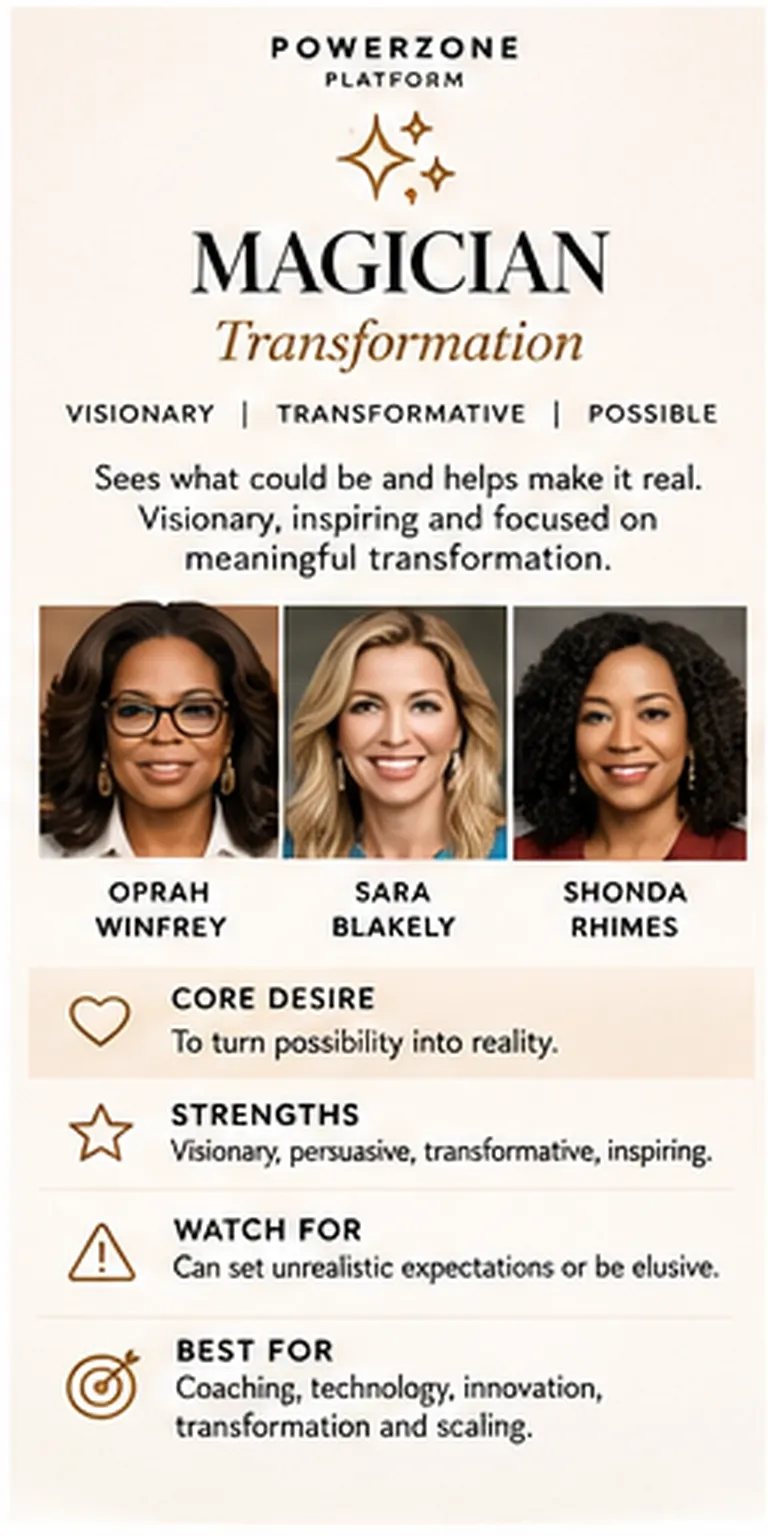
The Magician: Transformation, possibility and vision
Core desire: To turn possibility into reality.
The Magician sees what could exist, even when other people can't imagine it yet.
This archetype is visionary, transformational and focused on creating a meaningful shift.
Magician brands make people think, "I never realised that was possible."
Women who illustrate the Magician:
Oprah Winfrey, for the transformative role of her media and personal development work.
Sara Blakely, for turning a personal problem into a new product category.
Huda Kattan, for building a beauty empire from her expertise and audience.
Martha Stewart, for transforming domestic expertise into a multifaceted lifestyle business.
Shonda Rhimes, for creating powerful storytelling worlds and reshaping television representation.
Whitney Wolfe Herd, for rethinking aspects of online dating through Bumble.
For your business: The Magician is powerful for transformation coaches, business strategists, technology innovators, creative entrepreneurs and professionals helping clients achieve a dramatically different outcome.
Your marketing message might sound like: "Imagine what your business could become if the right systems, strategy and support were finally in place."
*Please note.... Currently I am not sure about Oprah's values from the talk of Epstein and some other men she has been linked to. We use her as an example for her media personality, We do not endorse her private life.
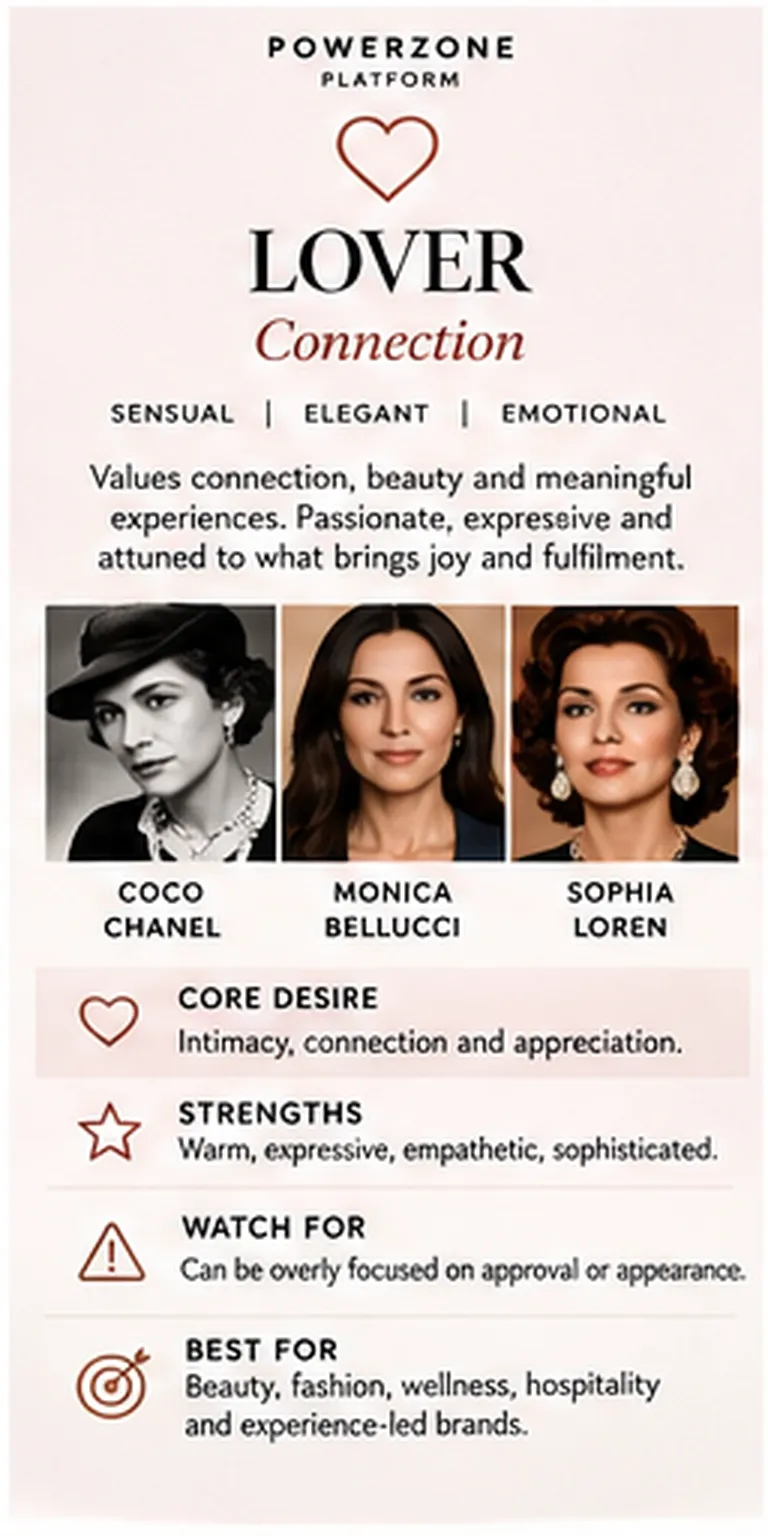
The Lover: Beauty, connection and emotional experience
Core desire: Intimacy, appreciation and meaningful connection.
The Lover appreciates beauty, quality, relationships and experiences that make people feel special.
It's not necessarily about romance or luxury.
It's about emotional connection and creating an experience people genuinely value.
Women who illustrate the Lover:
Coco Chanel, for the enduring association between her fashion legacy and elegance.
Monica Bellucci, for her sophisticated and sensual public image.
Sophia Loren, for her timeless glamour.
Charlotte Tilbury, for creating a beauty brand centred on glamour and confidence.
Estée Lauder, for her legacy of personal beauty experiences.
Diane von Furstenberg, for her celebration of femininity and confidence.
For your business: The Lover can work for beauty professionals, wedding planners, relationship coaches, hospitality businesses and premium lifestyle brands.
Your marketing message might sound like: "You deserve an experience that feels as thoughtful and individual as you are."
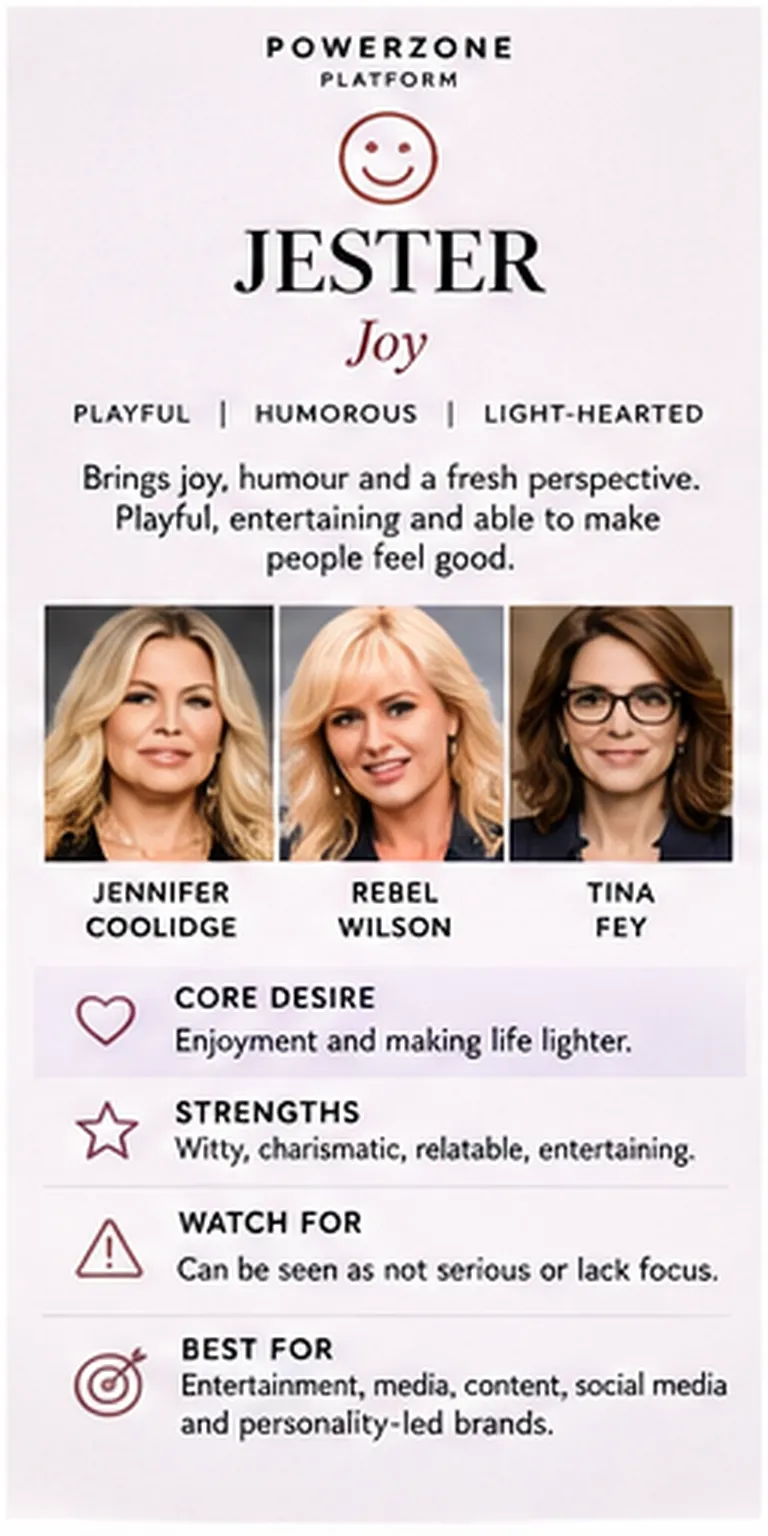
The Jester: Humour, joy and personality
Core desire: Enjoyment and making life a little lighter.
The Jester knows how to make people smile.
This archetype is playful, spontaneous, entertaining and often refreshingly honest.
Jester brands remind their audiences that not everything needs to be so serious.
And in industries filled with stiff corporate language, a little personality can be a significant advantage.
Women who illustrate the Jester:
Jennifer Coolidge, for her distinctive comedic personality.
Rebel Wilson, for her playful and comedic public persona.
Tina Fey, for her sharp observational humour.
Amy Poehler, for her wit and light-hearted approach.
Celeste Barber, for using humour to challenge unrealistic social media imagery.
Melissa McCarthy, for her bold comedic performances.
For your business: The Jester could work for a social media specialist, creative business, entertaining educator, podcast host or any entrepreneur who naturally uses humour to connect.
Your marketing message might sound like: "Your business systems shouldn't require a glass of wine and a small emotional breakdown to understand."
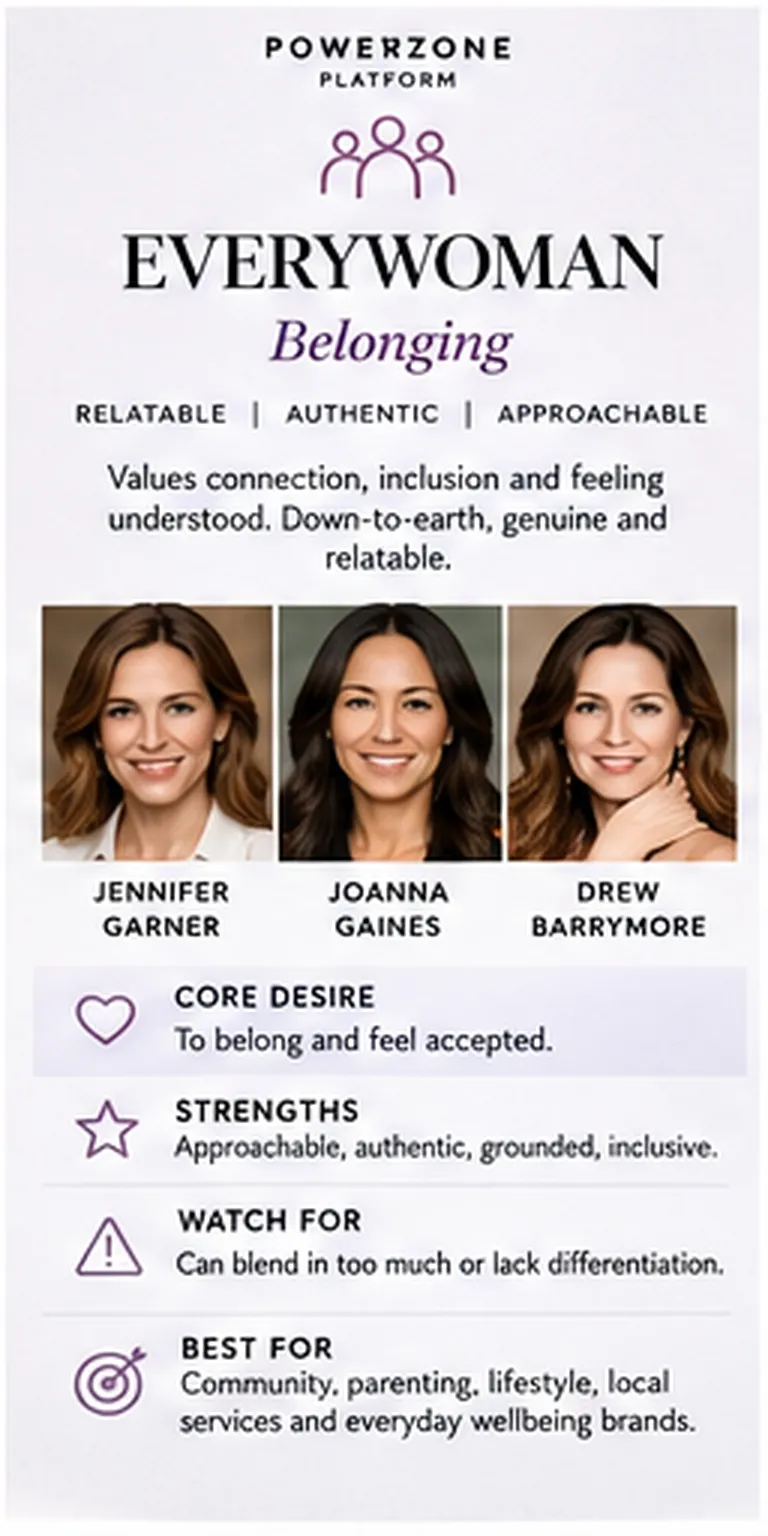
The Everywoman: Belonging, relatability and authenticity
Core desire: To belong and feel accepted.
Often called the Everyman in traditional brand archetype models, I'm using Everywoman here.
This archetype is relatable, approachable, grounded and authentic.
She isn't trying to impress people with how extraordinary she is.
She connects by making people feel understood.
Women who illustrate the Everywoman:
Jennifer Garner, for her approachable and relatable public persona.
Joanna Gaines, for her connection to everyday family and home life.
Drew Barrymore, for her open and conversational personality.
Stacey Solomon, for sharing relatable family and home experiences.
Rachael Ray, for making cooking feel accessible.
Emma Chamberlain, for her informal and relatable communication style.
For your business: This can be a particularly good fit for community builders, parenting coaches, local service providers and businesses built around shared experiences.
Your marketing message might sound like: "You don't need to have everything figured out. Most of us are working it out as we go."
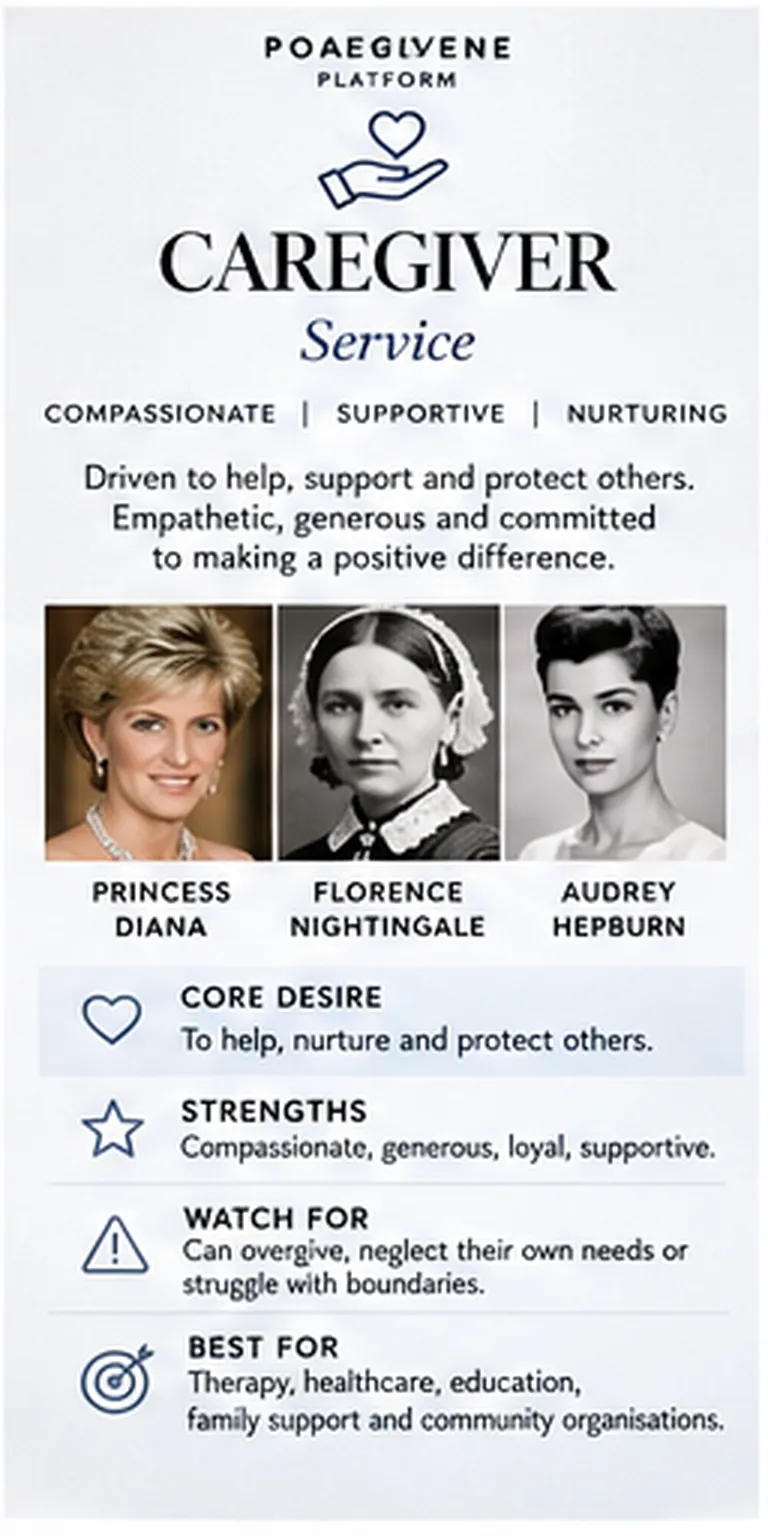
The Caregiver: Support, compassion and protection
Core desire: To help, nurture and protect others.
The Caregiver is driven by empathy, responsibility and service.
This archetype wants people to feel safe, supported and genuinely cared for.
Caregiver brands often thrive in industries where trust and emotional reassurance are essential.
Women who illustrate the Caregiver:
Princess Diana, for her humanitarian work and compassion.
Florence Nightingale, for her contribution to nursing.
Mother Teresa, for her public legacy of service.
Audrey Hepburn, particularly her humanitarian work with UNICEF.
Michelle Obama, for aspects of her advocacy for families, health and education.
Dame Cicely Saunders, for her pioneering work in hospice and palliative care.
For your business: The Caregiver can be a natural fit for therapists, healthcare professionals, family support services, educators, community organisations and wellness businesses.
Your marketing message might sound like: "You don't have to navigate this alone. We're here to help you take the next step."
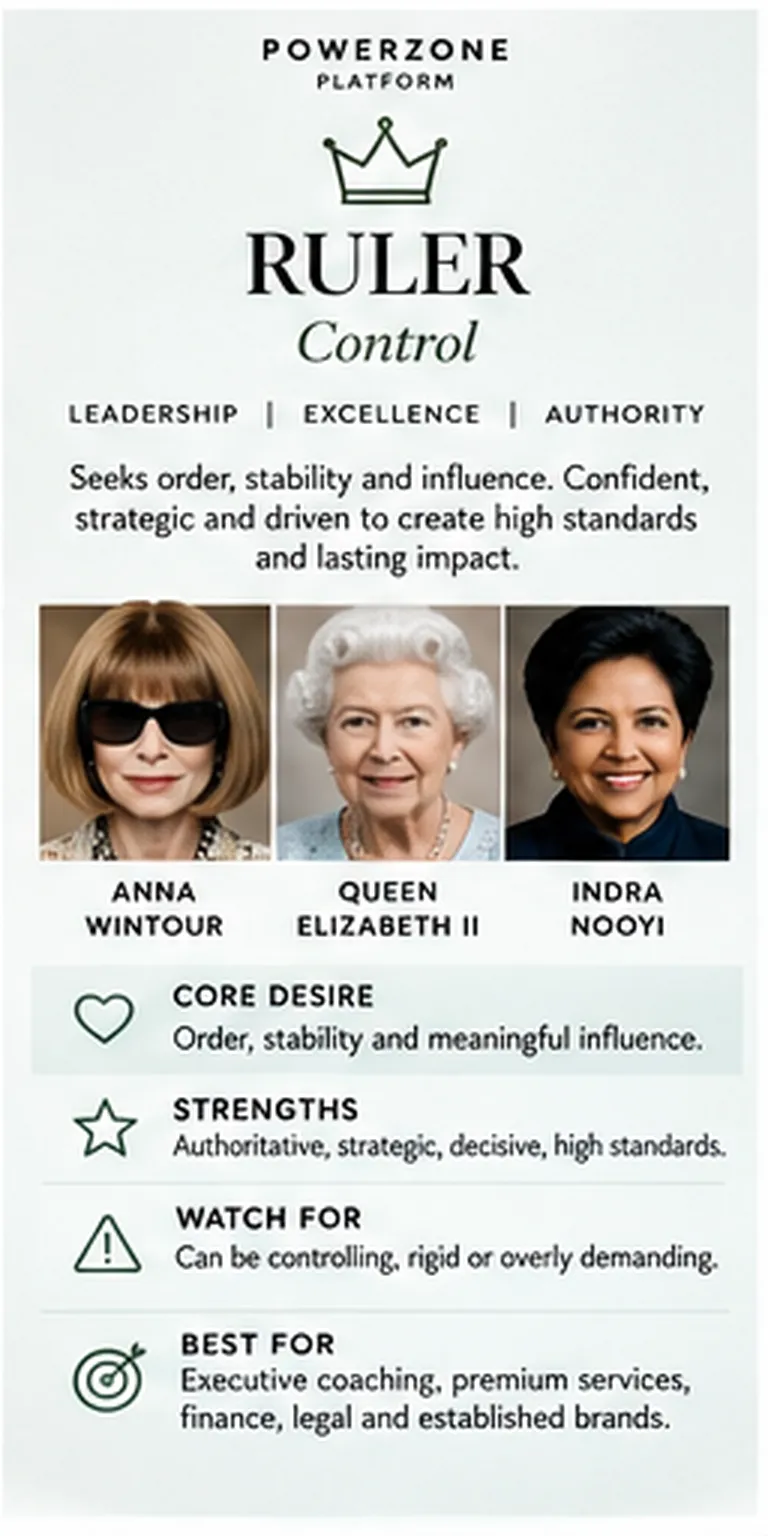
The Ruler: Leadership, excellence and authority
Core desire: Order, stability, influence and achievement.
The Ruler values leadership, quality, structure and high standards.
Ruler brands project confidence and authority.
They communicate that their customers are in capable hands.
But there's an important distinction between confidence and arrogance.
The strongest Ruler brands earn trust through competence, not simply by telling everyone how successful they are.
Women who illustrate the Ruler:
Anna Wintour, for her influence and authority within fashion.
Queen Elizabeth II, for her association with continuity, duty and leadership.
Indra Nooyi, for her corporate leadership.
Mary Barra, for her leadership at General Motors.
Christine Lagarde, for her influence in international finance.
Gina Rinehart, for her position in Australian business.
For your business: The Ruler may suit executive coaches, premium consultants, financial advisers, established professional services and businesses positioning themselves around excellence and reliability.
Your marketing message might sound like: "Exceptional results require exceptional standards."
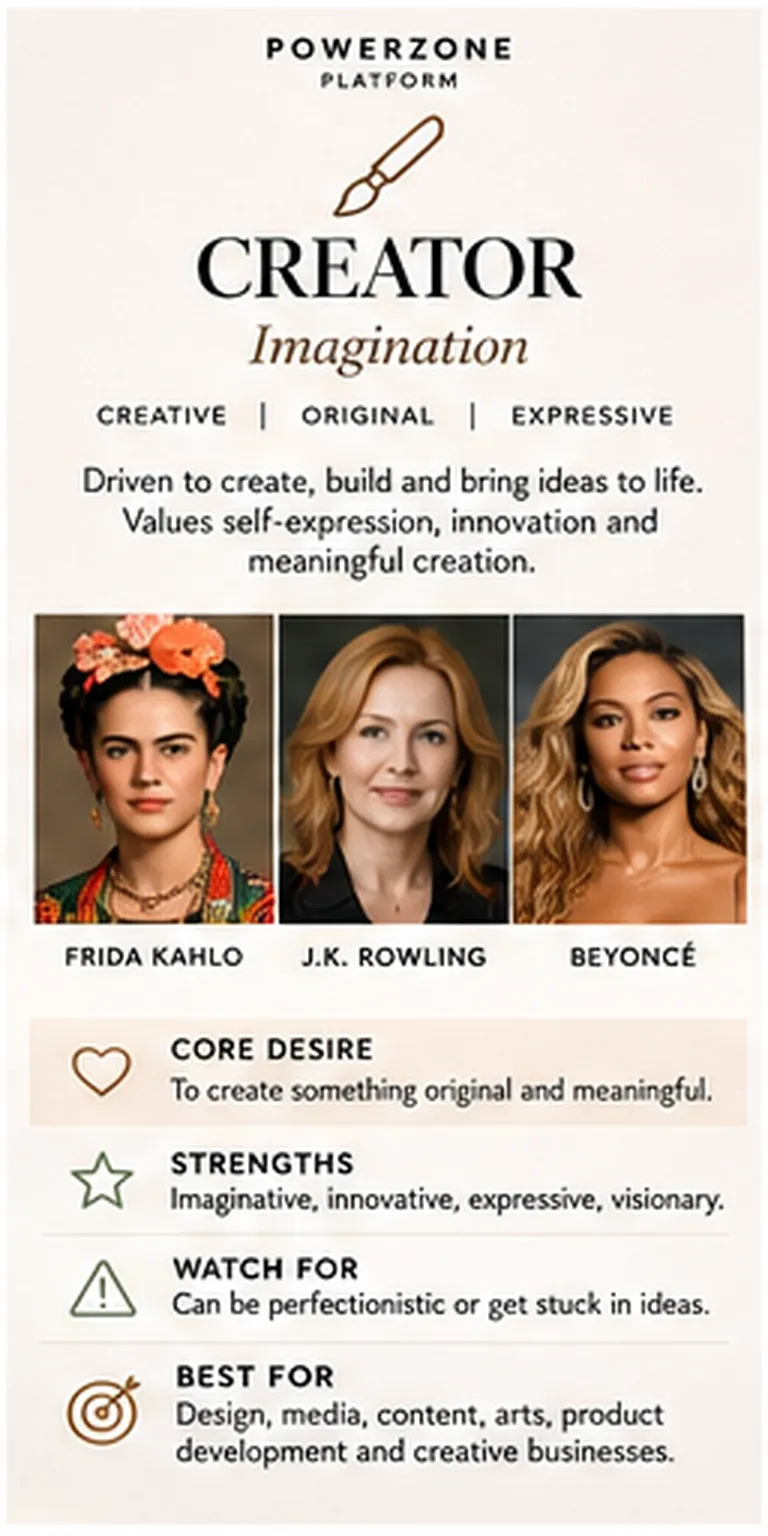
The Creator: Imagination, originality and innovation
Core desire: To build something meaningful and original.
The Creator values self-expression, creativity, innovation and the opportunity to bring ideas to life.
Creator brands inspire people to see possibilities and develop something of their own.
They aren't satisfied with repeating what everybody else is doing.
Women who illustrate the Creator:
Frida Kahlo, for her distinctive artistic identity.
J.K. Rowling, for her imaginative storytelling.
Vera Wang, for her creative vision in fashion.
Iris Apfel, for her unmistakable personal style.
Yayoi Kusama, for her instantly recognisable artistic expression.
Beyoncé, for her creative direction, performance and visual storytelling.
Stella McCartney, for her design-led approach to fashion.
For your business: The Creator is particularly relevant for designers, writers, content creators, photographers, branding specialists and entrepreneurs developing innovative products or experiences.
Your marketing message might sound like: "You have an idea worth bringing to life. Let's create something that actually reflects your vision."
Which brand archetype should you choose?
This is where I want you to be practical.
Your archetype isn't simply a personality quiz where you choose the woman you'd most like to be.
It's a business decision.
You need to consider three things:
1. Who are you genuinely?
How do you naturally communicate? What do you value? What do people consistently come to you for?
2. What does your customer need from you?
Are they looking for reassurance, education, inspiration, transformation, belonging or something else?
3. What outcome does your business deliver?
Do you help people understand something? Achieve something? Create something? Change something? Feel something?
The best brand personality sits where these answers meet.
For example, you might be naturally funny and outgoing, but if you're a family lawyer helping someone through a difficult separation, leading entirely with a Jester personality probably isn't appropriate.
You could, however, be a Sage who occasionally uses warm humour to make complicated legal information more approachable.
Likewise, a business coach might naturally be a Caregiver because she loves supporting people.
But her customers may actually come to her because they want transformation, growth and a business that operates differently.
That could make the Magician a stronger primary archetype, with the Caregiver supporting the way she works with clients.
Your brand personality needs to feel like you while meeting the emotional needs of the people you serve.
Why I recommend a primary and secondary archetype
I prefer businesses to start with one primary archetype and one secondary archetype.
The primary archetype provides the overall direction.
The secondary archetype adds personality and distinction.
For example:
PrimarySecondaryBrand personalitySageCaregiverKnowledgeable, supportive and reassuringHeroMagicianEmpowering, ambitious and transformationalMagicianCreatorVisionary, innovative and imaginativeRebelSageChallenging conventions with evidence and expertiseRulerLoverPremium, sophisticated and personalExplorerCreatorIndependent, adventurous and originalEverywomanJesterRelatable, approachable and entertainingCaregiverHeroCompassionate but action-orientedSageRebelEducational, questioning and unafraid to challenge assumptionsCreatorMagicianCreative ideas that lead to meaningful transformation
You might choose to think of your brand as approximately 70% primary archetype and 30% secondary.
That's not a scientific formula. It's simply a useful way to maintain clarity.
If every personality trait gets equal attention, your branding can end up feeling inconsistent.
And if your business is changing direction every few weeks, your audience has to keep working out who you are.
That's exhausting for them and usually pretty exhausting for you, too.
What this looks like for PowerZone Platform
Let me use PowerZone as an example.
PowerZone helps business owners understand their strengths, build their authority and put systems in place so they can spend more time doing the work they're actually brilliant at.
I could position PowerZone purely as a technology platform.
I could focus on software features, automations, appointment calendars, customer databases, online courses and all the technical things the platform can do.
But that's not why I built the business.
The technology is the tool.
The transformation is the reason.
I want a therapist to be able to grow beyond one-to-one appointments without spending every waking hour on administration.
I want a coach to turn her expertise into a group programme without feeling overwhelmed by the technology.
I want a service provider to stop trying to personally manage every little detail of her business.
And I want women who have spent years developing their expertise to feel confident building businesses that reflect the lives they actually want.
That makes the Magician a strong primary archetype for PowerZone.
It's about helping people see and create a different future.
But there's also a strong Hero element.
PowerZone encourages women to recognise their capabilities, take control of their businesses and make progress instead of remaining stuck.
And the Creator is part of the experience, particularly when helping clients turn their expertise into their own courses, programmes and services.
For the clearest brand positioning, though, I would lead with the Magician and use the Hero as the secondary influence.
The messaging becomes less about what the software does and more about what the business owner becomes capable of doing.
That's a significant difference.
Authority First. Visibility Second. Automation Always.
The systems support the ambition. They don't replace it.
How to turn your archetype into actual marketing
Choosing an archetype is the easy part.
The value comes from applying it consistently.
I would start with five areas.
1. Your brand messaging
Look at your website headline, social media bio, email introductions and sales pages.
Do they communicate the feeling associated with your brand?
A Sage might lead with clarity and expertise.
A Hero might lead with confidence and progress.
A Caregiver might lead with reassurance and support.
A Magician might lead with possibility and transformation.
You can sell exactly the same service in very different ways depending on your archetype.
2. Your tone of voice
How do you sound when you're communicating?
Are you direct, encouraging, warm, analytical, playful, challenging or refined?
Think about the words and expressions you naturally use.
You don't need to invent a completely new personality.
In fact, I would actively discourage that.
If you hate corporate language, don't suddenly start writing as though you've swallowed a management textbook.
Your audience needs to recognise the same person in your emails, podcast, social posts and client conversations.
3. Your visual identity
Your colours, typography, photography, layouts and overall design should support the personality you're building.
But here's something I want to emphasise.
An archetype does not automatically dictate a colour palette.
A Sage brand doesn't have to be blue.
A Caregiver brand doesn't have to be soft pink.
A Rebel brand doesn't have to use black and red.
Those are familiar visual associations, not rules.
You can express the same archetype through a completely different design style.
What's important is that your visuals communicate the right feeling and remain consistent.
For PowerZone, I prefer an elegant, editorial aesthetic. Clean layouts, strong typography, warm neutrals and carefully selected accent colours.
It communicates confidence, clarity and sophistication without turning every post into a software advertisement.
4. Your content strategy
Your archetype should influence the type of content you produce.
For example, a Sage might publish research summaries, educational carousels and myth-busting posts.
A Hero might share achievements, client progress, challenges and practical action plans.
A Magician might focus on before-and-after transformations, possibilities, innovations and different ways of working.
A Caregiver might share guidance, reassuring explanations and resources that make difficult situations easier to navigate.
A Rebel might question common industry advice and explain why a different approach could be better.
This doesn't mean you can only publish one type of content.
It means your audience should recognise a consistent point of view behind everything you share.
5. Your client experience
This is the part of branding that doesn't get enough attention.
Your personality must carry through to how people actually experience your business.
If your brand promises simplicity but your onboarding involves 14 confusing emails, something isn't working.
If you promote yourself as a Caregiver but your clients struggle to get responses, there's a disconnect.
If you're positioning yourself as a premium Ruler brand, your processes, communication and delivery should reflect those standards.
Your brand is not just what you say. It's also how you behave.
And that includes what happens after somebody pays you.
A quick exercise to find your brand archetype
Before you settle on an archetype, answer these questions.
Question 1: What do people come to you for?
Not just what they buy, but the deeper reason they choose you.
Do they want your knowledge, your encouragement, your creativity, your leadership or your ability to change something?
Question 2: What do you want people to say about your brand?
Imagine a client recommending you to a friend.
What three words would you love them to use?
Question 3: What do you stand against?
Perhaps you challenge unnecessarily complicated systems, unrealistic expectations, outdated industry advice or poor customer experiences.
What frustrates you enough that you want to do something differently?
Question 4: What emotional outcome do you provide?
Do your clients leave feeling confident, reassured, excited, empowered, informed or inspired?
Question 5: Which women do you admire and why?
Don't choose the woman with the biggest business or the most impressive lifestyle.
Think about the qualities you admire.
Perhaps it's Oprah's ability to communicate possibility, Serena's resilience, Brené Brown's curiosity or Anna Wintour's confidence.
What are you responding to?
Those characteristics may reveal something useful about the way you want to show up.
Question 6: Does your audience experience you that way already?
Look at your testimonials, client feedback, emails and conversations.
What words do people naturally use to describe working with you?
Your customers may already be telling you what makes your brand special.
You just haven't been paying attention to it.
*The mistake I don't want you to make
Please don't turn this into another exercise where you spend three weeks choosing colours, redesigning your logo and creating the perfect mood board.
Brand archetypes are useful because they help you make business decisions.
Not because they give you another excuse to procrastinate.
You can have the most beautiful branding in your industry and still struggle to attract customers if your messaging isn't clear.
Equally, you can have a relatively simple visual identity and build a highly recognisable business through consistent communication, valuable content and a clear point of view.
Clarity before decoration. Always.
Choose your archetype.
Decide how that personality should influence your messaging.
Create a simple set of brand guidelines.
Then start using them.
You can refine as you grow.
Your brand should grow with you
One final point.
Your archetype doesn't have to remain exactly the same forever.
Businesses evolve. Their customers change. Their products and services develop.
You might begin as a Caregiver, helping clients feel safe and supported, and gradually introduce more Sage or Ruler characteristics as your expertise and business mature.
You might start as a Creator, building everything yourself, and become more of a Magician as you shift towards helping other people achieve transformations.
That's entirely reasonable.
What matters is that the evolution feels intentional.
You don't want your audience waking up one morning wondering what happened to the business they originally connected with.
Final thoughts: Be recognisable, not everything
There are thousands of business coaches, therapists, consultants, service providers, creatives and entrepreneurs competing for attention.
And if you're trying to stand out by being a little louder, posting a little more or copying what somebody successful is doing, you're making marketing harder than it needs to be.
You already have your experiences, expertise, values and personality.
Your job is to communicate them more clearly.
Brand archetypes give you a practical framework for doing that.
Look at the women we've discussed throughout this article.
They don't all communicate the same way.
They don't all have the same personalities, audiences or ambitions.
And that's precisely the point.
You don't need to become the next Oprah, Serena, Rihanna or Anna Wintour. You need to build a brand that people recognise as yours.
One that reflects your strengths, connects with the right people and supports the business you actually want to build.
Because when your positioning is clear, your marketing gets easier.
You know what to talk about.
You know how to communicate.
You know what kind of content fits your brand and what doesn't.
And perhaps most importantly, you stop feeling like you have to be everywhere, doing everything, for everybody.
That's where better business systems, thoughtful strategy and a strong brand identity start working together.
Authority First. Visibility Second. Automation Always.
PowerZone Platform helps entrepreneurs turn their expertise into sustainable businesses through smarter marketing, client experiences and automation, so they can spend more time working in their genius zone.
Image Credits & Disclaimer: Illustrations and graphic design: © PowerZone Platform, 2026. Celebrity depictions within these graphics were created using AI-assisted illustration tools for educational purposes. The individuals featured are used as examples of publicly recognisable personality characteristics associated with brand archetypes. All archetype classifications are independent editorial interpretations by PowerZone Platform. No affiliation, sponsorship, endorsement or approval by the individuals depicted is implied.
Marketing that feels human.
Automation that feels effortless.
Results that feel inevitable.
FAQs
Do I need to know marketing to use this?
No.
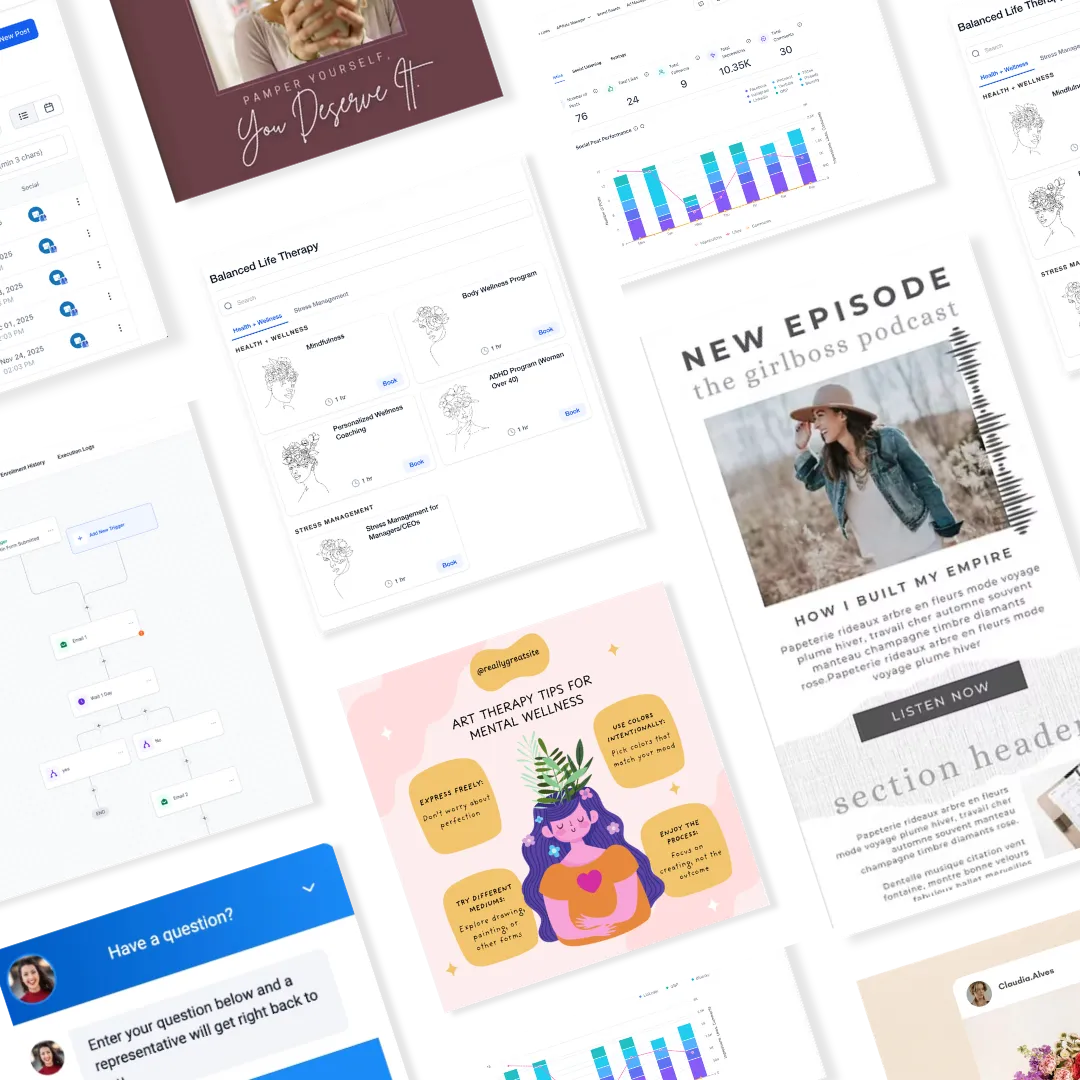
Everything inside PowerZone is pre-built for you — funnels, emails, landing pages, automations.
You customize the messaging, but the strategy and structure are already done.
Is this just another funnel builder?
No.
Most platforms give you blank pages and say “good luck.”
We give you therapist and coach-specific marketing systems designed to attract, nurture, and convert — not just collect emails.
Can I use this for more than 1:1 sessions?
Yes — and that’s the point.
PowerZone is built to support group programs, digital offers, webinars, workshops, waitlists, and launches. It’s designed for scaling beyond trading time for money.
Will this replace my other marketing tools?
In most cases, yes.
Instead of duct-taping 5-10 different platforms together, PowerZone gives you your CRM, funnels, email marketing, automations, booking, and follow-ups — all in one place.
“I love how easy the PowerZone Platform is.
No more linking 10 tools. I have 1 log in, everything works together.
This saves me hours each week."
— Martina Harrer, Naturopath
You’re not building from scratch.
You’re plugging into a platform built just for you.
Try it free for 14 days.
No pressure. Just results.

Resources
Get Help






© Copyright 2026 PowerZone Platform is part of the 20/80 Collective
Subpoena Policy | Terms and Conditions | Privacy | HIPAA & Data Compliance